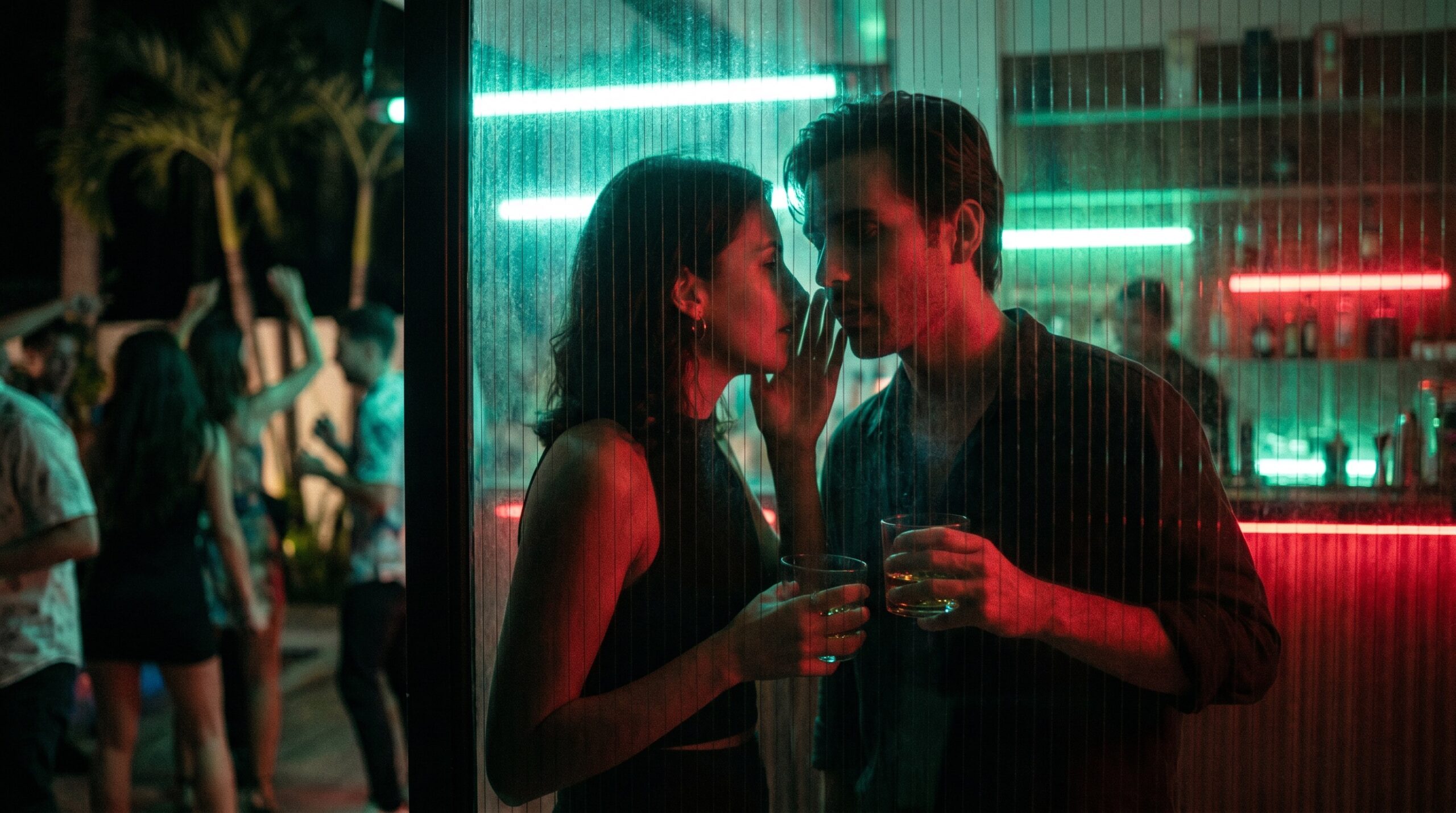
AI video has crossed an important line.
Until recently, most AI video tools felt like experiments. You could type a prompt, generate a short clip, and maybe get something interesting. But the process still felt unpredictable. The faces could shift. The motion could break. The camera could feel fake. The result often looked impressive for three seconds and unusable after that.
Seedance 2.0 changes the conversation because it makes AI video feel less like random generation and more like controlled visual production.
The biggest shift is not just better realism.
The biggest shift is the workflow.
We are moving from text prompting to reference-led directing.
The Old Way of AI Video Was Too Random
Earlier AI video workflows were mostly prompt-first.
You would write something like:
“Create a cinematic influencer GRWM video with soft luxury lighting, skincare, makeup, hair styling, and outfit selection.”
The model would then interpret everything on its own.
Sometimes it would work. Sometimes it would create a generic influencer scene. Sometimes the person would look different from shot to shot. Sometimes the lighting would feel too polished, too artificial, or too obviously AI-generated.
That was the problem.
The prompt carried too much pressure. One paragraph had to define the character, setting, visual style, camera language, motion, mood, sequence, transitions, and realism.
That is not how real production works.
In real production, we use moodboards, references, shot lists, lighting references, styling references, location references, and character continuity.
Seedance 2.0 makes that kind of workflow far more relevant.
The New Workflow Is Image First and Prompt Second
A stronger AI video workflow now looks like this:
- Create a visual sequence board first.
- Use that board as a reference.
- Then prompt Seedance to animate the sequence with realistic motion.
This is where things start becoming interesting for agencies, creators, and brands.
For example, imagine creating a complete GRWM sequence board of an Indian fashion and beauty influencer.
The board includes her morning opening, skincare setup, skincare routine, makeup time, hair styling, outfit selection, accessories, content moment, outfit reveal, last touch, and final ready-to-go shot.
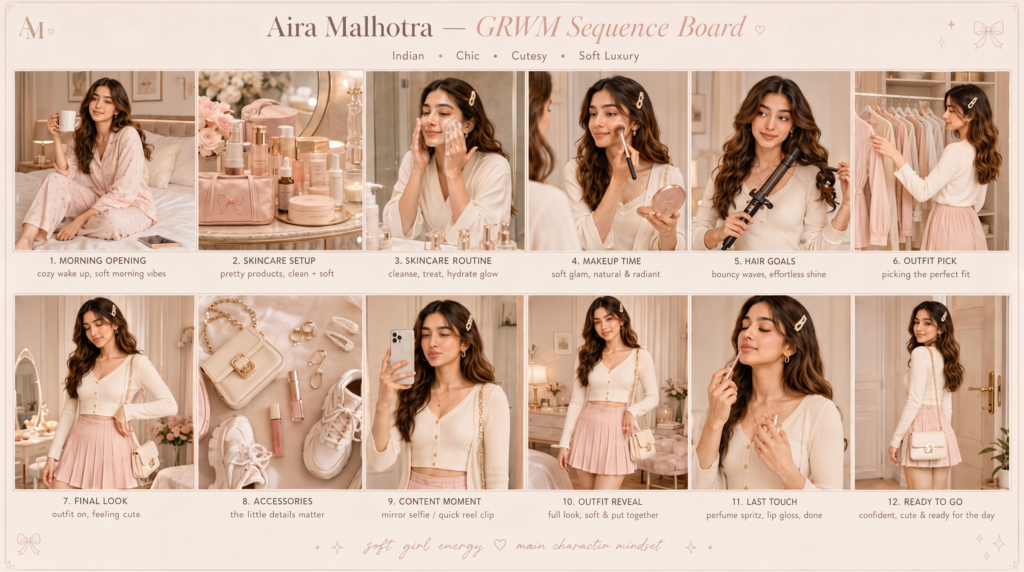
The visual tone is already defined.
Indian. Chic. Cutesy. Soft luxury. Warm lighting. Creamy pink palette. Elegant bedroom setting. Clean skincare products. Soft glam. Feminine styling. Influencer energy.
Now when this image is used as the reference and the prompt says:
“A cinematic influencer GRWM sequence. Beautiful soft luxury lighting, elegant transitions, showing morning routine, skincare, makeup, hair styling, and outfit selection, chic and aesthetic, photorealistic, realistic motion.”
The model is no longer inventing everything from scratch.
It has a visual blueprint.
That is the unlock.
Why This Example Matters
The GRWM example shows why Seedance 2.0 feels like a different category of tool.
The prompt itself is not extremely complicated. It is not a 500-word technical prompt. It is simple, clear, and production-oriented.
But the reason it works is because the reference image already does the heavy lifting.
- The character is defined.
- The styling is defined.
- The color palette is defined.
- The scene order is defined.
- The mood is defined.
- The camera world is defined.
- The content format is defined.
Seedance can then focus on what it is good at: bringing the sequence to life.
This is a very different way to think about AI video.
The prompt is no longer the whole creative direction.
The prompt becomes the instruction layer on top of a strong visual system.
Prompting Is Becoming Less About Words and More About Taste
Most people think prompting is about writing better sentences.
That is only partly true.
In AI video, prompting is becoming about taste.
The best outputs come from people who understand visual language.
- They know what warm luxury lighting looks like.
- They know what a realistic influencer room should feel like.
- They know when skin looks too plastic.
- They know when motion feels too smooth.
- They know when an AI scene looks fake because it is over-lit.
- They know how to make a moment feel observed instead of staged.
This is why “cinematic” alone is not enough.
Everyone writes cinematic.
But cinematic can mean dark Netflix thriller, clean Apple commercial, dreamy Korean skincare ad, chaotic handheld documentary, or glossy perfume film.
A good prompt defines the exact cinematic world.
For the GRWM example, the visual world is not just cinematic. It is soft luxury influencer cinema.
That means warm practical lighting, gentle movement, delicate transitions, soft fabric textures, pastel styling, realistic beauty routine gestures, and natural camera rhythm.
Seedance 2.0 Makes Sequence Boards More Valuable
This is a huge shift for creative teams.
Earlier, a storyboard or moodboard was mostly a pre-production asset. It helped clients imagine the shoot before anything was filmed.
Now the storyboard can become the source material for the AI video itself.
That means a designer can create a 12-frame campaign sequence using GPT Image 2 or another image model. Then Seedance can use that visual system to generate a realistic motion version.
This makes sequence boards more powerful than ever.
- A beauty brand can test a GRWM campaign before shooting.
- A fashion brand can test outfit reveal reels.
- A food brand can test recipe videos.
- A real estate brand can test lifestyle walkthroughs.
- A fintech brand can test founder-led explainers.
- A D2C brand can test product routines.
- An agency can pitch three different campaign routes in video form before production begins.
This does not remove the need for real shoots.
But it changes what happens before the shoot.
- The idea can be seen earlier.
- The client can approve faster.
- The creative direction can become clearer.
- The production team can understand the desired output better.
- The brand can test multiple routes before spending on a full campaign.
Seedance Is Not Replacing Production Yet
It is tempting to say that Seedance 2.0 replaces video production.
That is not fully true.
There are still limitations.
- Product accuracy can be difficult.
- Hands can still behave strangely.
- Faces may shift if the reference is weak.
- Logos and text are still risky.
- Complex multi-character scenes need control.
- Exact brand assets may need post-production.
- Final ad delivery may still need editing, sound design, grading, and human cleanup.
But for concepting, previsualization, social content testing, mood films, pitch videos, and early creative exploration, it is already extremely useful.
The correct way to use Seedance 2.0 is not as a magic button.
It should be used as a creative production layer.
The Best Prompting Formula for Seedance
A strong Seedance prompt should not be messy.
It should be clean, visual, and directional.
A useful structure is:
- Subject
- Scene
- Action
- Sequence
- Camera
- Lighting
- Mood
- Realism
- Restrictions
For example:
“A cinematic influencer GRWM sequence featuring a stylish Indian creator in a soft luxury bedroom. Show her morning opening, skincare routine, makeup, hair styling, outfit selection, accessories, mirror selfie, final look, and ready-to-go moment. Warm creamy lighting, pastel pink and beige palette, elegant transitions, natural beauty gestures, realistic human motion, soft handheld camera feel, shallow depth of field, photorealistic skin texture, chic and aesthetic, no text overlays, no distorted hands, no fake glossy AI look.”
This gives the model a real production brief.
It tells Seedance what to show, how to move, what to feel like, and what to avoid.
The Real Skill Is Building the Input
The best AI video teams will not just write prompts.
They will build inputs.
That means:
- Character sheets
- Moodboards
- Sequence boards
- Product boards
- Reference images
- Camera references
- Lighting references
- Styling references
- Shot-by-shot prompts
- Negative prompt libraries
- Brand-specific visual rules
This is where agencies can create real value.
Anyone can type “make a cinematic video.”
But not everyone can build a complete visual system that makes the video look intentional.
The GRWM example proves this clearly.
The prompt is simple because the reference is strong.
That is the future of AI video.
Strong inputs. Clear prompts. Better outputs.
What This Means for Brands
For brands, Seedance 2.0 opens up a faster way to test content ideas.
Instead of waiting weeks to visualize a campaign, a brand can now see a realistic draft in a day.
This is especially useful for:
- Influencer campaigns
- Beauty routines
- Fashion reels
- Product demos
- UGC-style ads
- Founder stories
- Launch teasers
- Website hero videos
- Campaign mood films
- Performance ad variations
The brand does not need to immediately commit to a full shoot.
It can first test the world.
- Does this tone feel right?
- Does this character work?
- Does this product routine feel natural?
- Does this campaign have motion?
- Does this look premium enough?
- Does it feel too AI?
- Can this become a real shoot?
That is a major creative advantage.
What This Means for Agencies
For agencies, Seedance 2.0 creates a new service layer.
The agency can move from static moodboards to motion moodboards.
Instead of only presenting campaign routes as slides, agencies can present living campaign directions.
- A beauty campaign can be shown as a realistic GRWM sequence.
- A restaurant campaign can be shown as a cinematic food moment.
- A real estate campaign can be shown as a lifestyle walkthrough.
- A fintech campaign can be shown as a day-in-the-life visual story.
- A fashion campaign can be shown as an outfit transition reel.
This makes creative pitching stronger.
Clients do not have to imagine as much.
They can see the idea.
The Future Is Not Prompt Engineering
Prompt engineering sounds too technical.
What we are actually moving toward is creative direction.
The best people using Seedance will not be the ones who know secret keywords.
They will be the ones who understand storytelling, framing, lighting, styling, emotion, realism, platform behavior, and brand tone.
They will know how to make something feel less AI and more human.
- They will know when to use a reference image.
- They will know when to use a sequence board.
- They will know when to keep the prompt simple.
- They will know when to control the shot.
- They will know when to stop over-directing.
That is the new skill.
Not prompting.
Directing.
Final Takeaway
Seedance 2.0 changes everything because it makes AI video feel more controllable, more realistic, and more useful for actual creative work.
But the real breakthrough is not just the model.
The breakthrough is the workflow.
When you combine a strong visual reference, a clear sequence board, and a simple but well-directed prompt, AI video stops feeling like a random experiment.
It starts feeling like a production tool.
The GRWM example proves the point perfectly.
A single beautifully designed sequence board can become a realistic influencer video with the right Seedance prompt.
That is why the future of AI video will belong to creative teams who can think visually before they prompt.
Because the next era is not about typing better.
It is about directing better.