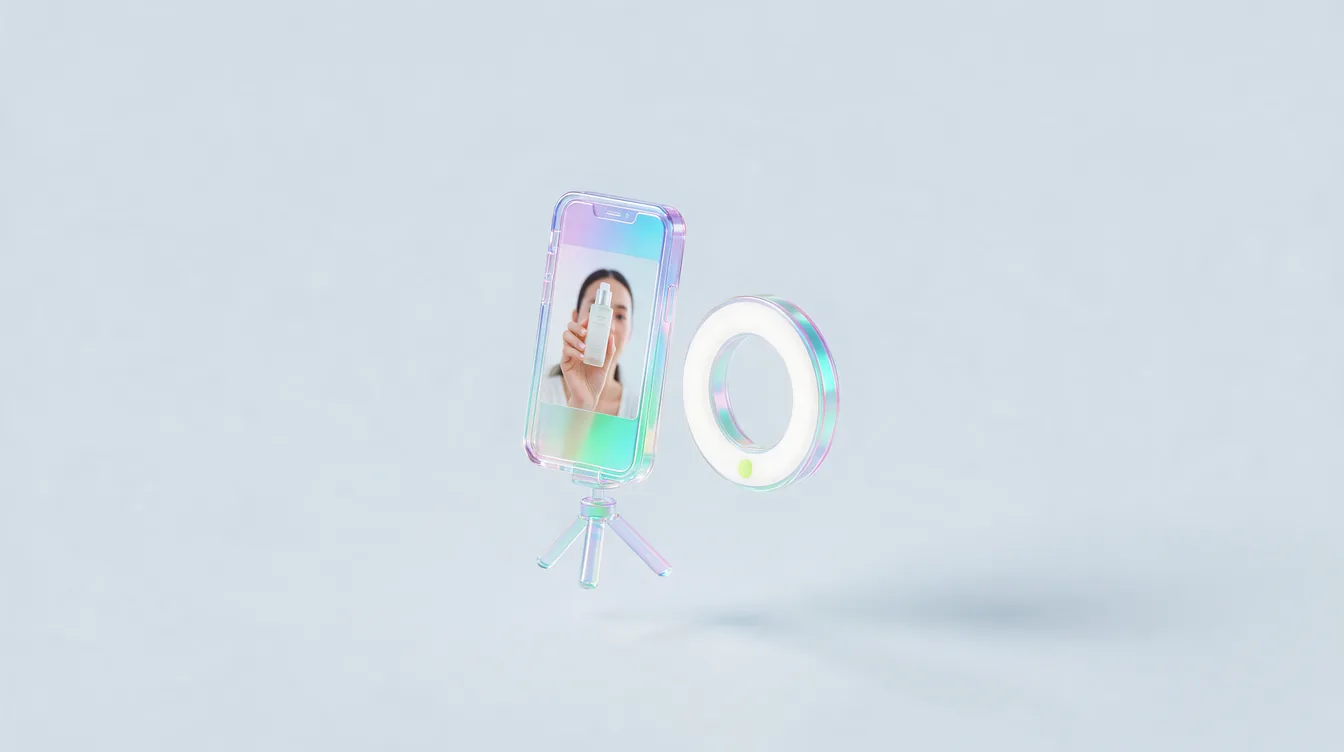
UGC stands for user generated content. If you are asking what is UGC content, the short answer is this: it is content about a brand that looks like it was made by a real customer, not by the brand. A phone video of someone unboxing a serum. A shaky review of a protein bar in a car. A screen recording of someone actually using an app.
A UGC creator is a person who makes that style of content for brands, for a fee. They are usually not famous. They do not need followers. They are paid for the video, not for their audience, and the brand posts it on its own page or runs it as an ad.
The rest of this guide covers how UGC differs from influencer marketing, how UGC ads work, how to brief and pay UGC creators in India, and how to become one.
What is UGC content? UGC meaning on social media
UGC originally meant content that genuine customers made on their own. Someone loved your kurta, posted a mirror selfie and tagged you. Nobody paid them. That still exists, and it is still the best kind.
But in the last few years, “UGC” on social media has come to mean something more specific: paid content made in the customer style. Brands realised that a raw, talking to camera video often beats a polished studio ad, so a whole industry of UGC creators grew up to make those videos on demand.
So when people say UGC today, they usually mean one of three things:
- Organic UGC. Real customers posting about you without being paid. Reviews, tags, unboxings, comments, photos.
- Incentivised UGC. Customers who get a free product, a discount or a contest entry in exchange for posting.
- Paid UGC. Creators hired to make customer style videos that the brand owns and uses, mostly in ads.
When someone searches for UGC videos meaning, they almost always mean that third type: short vertical videos, usually 15 to 60 seconds, filmed on a phone, made to feel like a friend’s recommendation.
UGC vs influencer marketing
This is where most brands get confused, and where most budgets leak. They are related, but they are not the same thing.
An influencer is paid for their audience. You are buying access to their followers, their trust, their reach. A UGC creator is paid for their content. You are buying a video you can use on your own channels and in your own ads.
| UGC creator | Influencer | |
|---|---|---|
| What you pay for | The video and the rights to use it | Their audience and their endorsement |
| Followers needed | None | Usually thousands to millions |
| Where it is posted | Your page, your ads, your website | Their page |
| Typical goal | Ad creative, conversion, testing | Awareness, trust, reach |
| Cost driver | Number of videos, usage rights, edits | Follower count, engagement, category |
| Control | High, you brief and approve | Lower, it has to feel like them |
| Shelf life | As long as the ad keeps working | Mostly the first few days |
Neither is better. Influencers create demand. UGC helps you convert it. The best brands use both. We go deeper on the influencer side in our influencer marketing in India guide.
Why UGC works so well
It is not magic. It is how people scroll.
People have trained themselves to skip anything that looks like an ad. A glossy product shot screams “ad” in half a second. A person talking to camera in their bedroom looks like content, so it gets a few more seconds. Those seconds are the whole game.
UGC also answers objections in a human way. “Does this sunscreen leave a white cast?” lands better when a real face shows you, on real skin, in real light. It feels like proof rather than a claim.
And it is cheap in volume. A studio shoot might give you three ads. The same budget across UGC creators can give you twenty. If you want the ad side of this argument, read why your ads are dying a slow, boring death.
What UGC ads are and how they work
UGC ads are paid ads that use UGC style creative. You take a creator’s video and run it through Meta Ads Manager, YouTube or another platform, targeting people who are likely to buy.
There are two main ways to run them:
- From your brand page. You get the raw video, edit it, and run it as a normal ad from your account. Simple and fully in your control.
- From the creator’s handle. On Meta this is done through partnership ads, where the ad shows the creator’s name alongside yours. This often feels more native and can perform better, but the creator has to grant you access, and you need to agree on it in the contract.
The anatomy of a UGC ad that converts
Most good UGC ads follow a loose structure. Not a script to read word for word, but a shape.
- Hook, 0 to 3 seconds. A line, visual or action that stops the scroll. “I was spending 4,000 a month on skincare until I found this.” Or just opening the box mid action.
- Problem. The pain the viewer recognises. Dry hair, slow laptop, boring lunches, messy GST filing.
- Product in use. Show it working. Real hands, real results, real setting.
- Proof. A before and after, a specific detail, a reason to believe.
- Call to action. Tell them what to do. “Link is right there, use code X for the first order.”
The hook is where we spend most of our testing effort. The same body with five different hooks can perform very differently.
How to brief UGC creators
A bad brief gets you thirty identical “hey guys, so I tried this” videos. A good brief gets you thirty different angles you can actually test.
Here is the brief template we use. Copy it.
1. Product basics. What it is, the price, who it is for, the one thing that makes it different.
2. Audience. Who we are talking to in one or two lines. “Working women in metros, 25 to 35, who have tried three hair oils and trust none of them.”
3. The angle. One idea per video. Problem solution, myth busting, unboxing, comparison, day in the life, “three reasons I switched.” Assign different angles to different creators.
4. Hooks to try. Give three or four suggested opening lines, and let the creator add their own.
5. Must say. Key claims you need, phrased in a way your legal and compliance team is comfortable with. Keep this list short.
6. Must not say. Banned claims, competitor names, medical promises, anything that will get the ad rejected or get you in trouble.
7. Technical specs. Vertical 9:16, natural light, clean audio, no background music (you will add it), raw files plus one edited version, no burnt in captions unless you ask.
8. Deliverables and deadline. Number of videos, number of hook variations, length, delivery date, number of revision rounds.
9. Usage rights. Where you will use it, for how long, and whether you can run it as an ad from their handle.
A note on language. In India, Hindi and Hinglish UGC often outperforms polished English for mass market products. Tamil, Telugu, Marathi, Bengali and Kannada creators can unlock regional audiences that English ads barely touch. Brief in the language you want, not in English with a hope.
UGC brief mistakes to avoid
- Writing a full script. The moment a creator reads lines, it stops looking like UGC. Give talking points, not dialogue.
- Asking for ten claims in 30 seconds. Pick one message. The rest can go in other videos.
- Sending the product late. Creators need time to actually use it. A face cream used for one night will look like it.
- No usage terms in writing. Settle rights before anyone presses record.
How much to pay UGC creators in India
Rates vary a lot by experience, language, category and what you are asking for. There is no official rate card. These are rough ranges we typically see in the Indian market as of late 2026, and they will move.
| Creator level | Typical rate per video | What you usually get |
|---|---|---|
| Beginner, building a portfolio | Free product to around ₹2,000 | One raw video, basic quality |
| Regular UGC creator | ₹2,000 to ₹8,000 | One video, a couple of hook variations, decent audio and lighting |
| Experienced, with ad results | ₹8,000 to ₹25,000 | Strong hooks, editing, multiple variations, a track record of performance |
| Specialist or niche expert | ₹25,000 and above | Doctors, chefs, fitness coaches, tech experts, regulated categories |
Then there are extras that change the price:
- Usage rights. Organic use on your page is cheapest. Paid ad usage costs more. Long term or unlimited usage costs more again. In our experience, ad usage often adds anywhere from 25 to 100 percent on top of the base fee, depending on duration.
- Hook variations. Extra opening lines on the same video are cheap to shoot and very valuable to test. Pay for them.
- Editing. Raw files cost less. Fully edited, captioned versions cost more.
- Whitelisting or partnership ads. Running ads from the creator’s handle usually comes with a separate fee.
- Exclusivity. If you do not want them working with competitors for three months, you pay for that.
A worked example budget
Say you are a D2C snack brand and you want to test UGC ads properly for the first time. Here is a sensible starting plan.
- 8 creators at around ₹5,000 each for one video with three hooks: ₹40,000
- Paid usage for 6 months: roughly ₹15,000 to ₹20,000 extra across all creators
- Product samples and shipping: ₹5,000 to ₹10,000
- In house or freelance editing for cut downs: ₹10,000 to ₹20,000
Total creative cost: roughly ₹70,000 to ₹90,000 for 24 testable ad variants. Then you need ad spend on top to test them. Even a modest ₹1,00,000 to ₹2,00,000 test budget will tell you which angles and which faces your audience responds to.
Compare that to a single studio shoot, and you can see why UGC took over performance marketing.
How to find UGC creators
You do not need a big platform to start. You need a short list and a clear process.
- Your own customers. Check tags, reviews and comments. People who already love you make the most honest UGC.
- Instagram, YouTube and LinkedIn. Search “UGC creator India”. Many creators share portfolios and rate cards openly.
- Creator marketplaces. They save time but take a cut.
- An agency. Useful when you need volume, contracts, rights and editing handled in one place. That is what our creators team does.
How to pick the right UGC creator
Do not pick based on followers. Pick based on this checklist.
- Do they look and sound like your customer?
- Is their audio clean in their samples?
- Do their first three seconds make you want to keep watching?
- Do they show the product in use or just hold it up?
- Do they deliver on time? Ask for a reference if the job is big.
- Have any of their videos run as ads, and can they share rough results?
How to test and scale UGC ads
Getting the videos is half the work. The other half is finding out which ones actually sell.
- Launch in batches. Put several videos into one test with the same audience and budget, so they compete fairly.
- Judge the hook first. Look at how many people watch past the first three seconds. A weak hook kills a good video.
- Then judge the body. Look at hold rate, click through rate and cost per purchase or lead.
- Kill fast, feed winners. Turn off the losers within a few days of meaningful spend. Move budget to winners.
- Iterate on winners. Same creator, new hook. Same angle, new creator. Same script shape, new product.
- Refresh before fatigue. Even winners wear out. Keep a pipeline of new videos coming every few weeks.
This boring loop is behind most successful D2C ad accounts. A performance marketing agency should be running this loop for you, not just adjusting budgets.
UGC contracts and rights in India
This is the part everyone skips and then regrets. Put these things in writing, even if it is a simple one page agreement or a clear email.
- Number of videos, length, format and revisions
- Payment amount, schedule and how GST or TDS will be handled, if applicable
- Where the content can be used: organic, paid ads, website, marketplaces, offline
- How long you can use it, and what happens after
- Whether you can edit, cut and combine the footage
- Whether you can run ads from the creator’s handle
- Any exclusivity period
- Disclosure: in India, ASCI guidelines expect paid endorsements on social media to be clearly disclosed, so agree on how the creator will label anything they post on their own page
If you are unsure about tax or legal specifics, ask your CA or lawyer. A small conversation now saves a big argument later.
How to become a UGC creator in India
If you are on the other side and wondering how to become a UGC creator, here is the honest version. You do not need followers. You do need taste, consistency and a decent phone.
- Pick two or three categories you actually use. Skincare, food, fitness, tech, parenting, home, finance apps. Credibility comes from real use.
- Make spec videos. Buy or use products you already own and make sample ads as if a brand hired you. Five to ten good samples is enough to start.
- Learn the basics of an ad. Hook, problem, product, proof, call to action. Study ads in the Meta Ad Library to see what brands are running.
- Get your setup right. Natural light near a window, a cheap clip on mic, a clean background, a tripod. Audio matters more than video quality.
- Build a simple portfolio. A Google Drive folder, a one page site or a dedicated Instagram account. Show your best three videos first.
- Pitch brands directly. Short DM or email, one sample relevant to their product, a clear rate. Small D2C brands are often the most open.
- Raise rates with proof. Once a brand tells you your video performed as an ad, that is your best sales line.
The creators who last think like marketers. Brands pay for results, not a pretty face.
Common UGC mistakes brands make
- Judging UGC by likes. It is ad creative, not reach. Judge it by ad results.
- Overproducing it. Add a studio light, a script and three rounds of feedback, and you have paid for UGC and turned it into the TV ad it was meant to beat.
- Testing one video and giving up. You need volume to find winners.
- Ignoring organic UGC. Your happiest customers are already making content. Ask permission and use it.
FAQ
What is UGC content in simple words?
UGC content is content about a brand that looks like it was made by a real customer. It can be made by genuine customers for free, or by paid UGC creators who make customer style videos for brands to use on their pages and in ads.
What is a UGC creator?
A UGC creator is someone who makes photos or short videos for brands in a natural, customer style. They are paid for the content and its usage rights, not for their followers. Many UGC creators have very small audiences, and that is fine.
What is the difference between UGC and influencer marketing?
With influencer marketing, you pay for someone’s audience and their post on their own page. With UGC, you pay for the content itself and use it on your own channels, mostly as ads. Influencers build awareness, UGC usually drives conversions.
How much does a UGC video cost in India?
In our experience, rates typically range from free product for beginners to ₹2,000 to ₹8,000 for regular creators, and ₹8,000 to ₹25,000 or more for experienced or specialist creators. Paid ad usage rights, extra hooks, editing and exclusivity usually cost extra.
Do UGC creators need followers?
No. A UGC creator’s value is in the quality of the video, how well it hooks and how believable it feels. A portfolio of good sample videos matters far more than follower count.
Are UGC ads better than regular ads?
Not always, but they often perform well on social platforms because they look like content rather than ads. The real advantage is volume: you can test many angles and faces cheaply and scale the ones that work. Most strong ad accounts mix UGC with other formats.
Want UGC that actually sells?
UGC is not a trend. It is how people decide what to buy now: they watch someone like them try it first. The brands that win treat it as a system, with clear briefs, fair pay, proper rights and constant testing.
If you want help finding creators, writing briefs and turning the videos into ads that convert, take a look at our creators and UGC work, or tell us what you are selling. We will tell you honestly whether UGC is the right next move.
Hungry for more?
Let’s put this thinking to work on your brand.