Let’s be real for a second. Most of you are obsessed with the wrong thing. You spend your days tweaking pixels, sweating over click-through rates, and acting like your targeting strategy is some kind of holy grail. Spoiler alert: nobody gives a damn about your “precision audience.” You’re chasing the crumbs while the whole cake is rotting right under your nose.
The data is out, and it’s a slap in the face: creativity is the only thing that actually moves the needle. If your ads are as dry as a desert, your ROI is going to stay in the gutter, no matter how many bots you target.
Stop Jerking Off to Vanity Metrics
Why are you so obsessed with “safe” metrics? Because they’re easy. It’s the marketing equivalent of a participation trophy. You’re hiding behind impressions, traffic, and engagement because you’re terrified of the real game: profit, market share, and actual, cold, hard growth.
The least confident marketers are the ones counting clicks. The heavy hitters? They’re playing for the long haul. They know that if your creative isn’t hitting the gut, you’re just wasting money on digital noise. You’re not being “data-driven”; you’re being lazy.
The “Targeting” Myth
We’ve been fed a lie that targeting is the secret sauce. Please. Precision targeting is like using a microscope to look at a tumor while ignoring the fact that your brand is bleeding out.
The multipliers don’t lie. Creative quality is a beast, dwarfing your pathetic little targeting tweaks. You are pouring your entire budget into the mechanism of delivery while starving the actual content of any personality. It’s like buying a Ferrari and then putting cheap, watered-down gas in the tank. Stop overvaluing the “where” and start giving a damn about the “what.”
The Four Commandments of Creative Success
If you want your brand to actually get laid in the marketplace; meaning, you want customers to actually pick you—you need to stop being so damn boring.
1. Make Them Feel Something, or Get Out
If your ad doesn’t make people feel something—joy, anger, lust, nostalgia, anything; you’re dead weight. Neutrality is the silent killer. Boring, “safe” ads are just expensive wallpaper. If you aren’t provoking a reaction, you’re just background noise that people scroll past without a second thought.
2. Don’t Be a “Ghost” Brand
There is nothing more pathetic than a great ad that nobody remembers. If you create a masterpiece but don’t make it blindingly obvious who you are, you’ve just done the heavy lifting for your competition. Build your distinctive assets, your jingles, your characters, your visual vibe and jam them down the audience’s throat until they can’t think of the category without thinking of you.
3. Stop Trying to Be “Safe”
Safe is for cowards. Safe is for brands that want to be forgotten. The most successful work is often the boldest, the most entertaining, and the most unapologetic. If you’re too scared to offend someone, you’re too scared to be memorable. Being ignored is the most expensive mistake you can make; don’t make it a habit.
4. Build a Legacy, Don’t Just Churn Content
Stop “refreshing” your brand every six months because some bored intern decided the old look was “dated.” Consistency is where the money is. Keep the same tone, the same assets, and the same damn message. That’s how you build mental real estate. Treat your creative like an asset that grows in value, not a disposable napkin.
The Bottom Line
Creativity is the only lever that actually compounds. Everything else is just incremental noise. As the rest of the market drowns in a sea of sterile, data-optimized, soul-crushing “performance” ads, the brands that lean into raw, emotional, consistent creativity are going to own the market.
Are you going to keep playing it safe and boring your customers into oblivion, or are you going to stop overthinking and start building something that people actually give a damn about?
Until recently, most AI video tools felt like experiments. You could type a prompt, generate a short clip, and maybe get something interesting. But the process still felt unpredictable. The faces could shift. The motion could break. The camera could feel fake. The result often looked impressive for three seconds and unusable after that.
Seedance 2.0 changes the conversation because it makes AI video feel less like random generation and more like controlled visual production.
The biggest shift is not just better realism.
The biggest shift is the workflow.
We are moving from text prompting to reference-led directing.
The Old Way of AI Video Was Too Random
Earlier AI video workflows were mostly prompt-first.
You would write something like:
“Create a cinematic influencer GRWM video with soft luxury lighting, skincare, makeup, hair styling, and outfit selection.”
The model would then interpret everything on its own.
Sometimes it would work. Sometimes it would create a generic influencer scene. Sometimes the person would look different from shot to shot. Sometimes the lighting would feel too polished, too artificial, or too obviously AI-generated.
That was the problem.
The prompt carried too much pressure. One paragraph had to define the character, setting, visual style, camera language, motion, mood, sequence, transitions, and realism.
That is not how real production works.
In real production, we use moodboards, references, shot lists, lighting references, styling references, location references, and character continuity.
Seedance 2.0 makes that kind of workflow far more relevant.
The New Workflow Is Image First and Prompt Second
A stronger AI video workflow now looks like this:
Create a visual sequence board first.
Use that board as a reference.
Then prompt Seedance to animate the sequence with realistic motion.
This is where things start becoming interesting for agencies, creators, and brands.
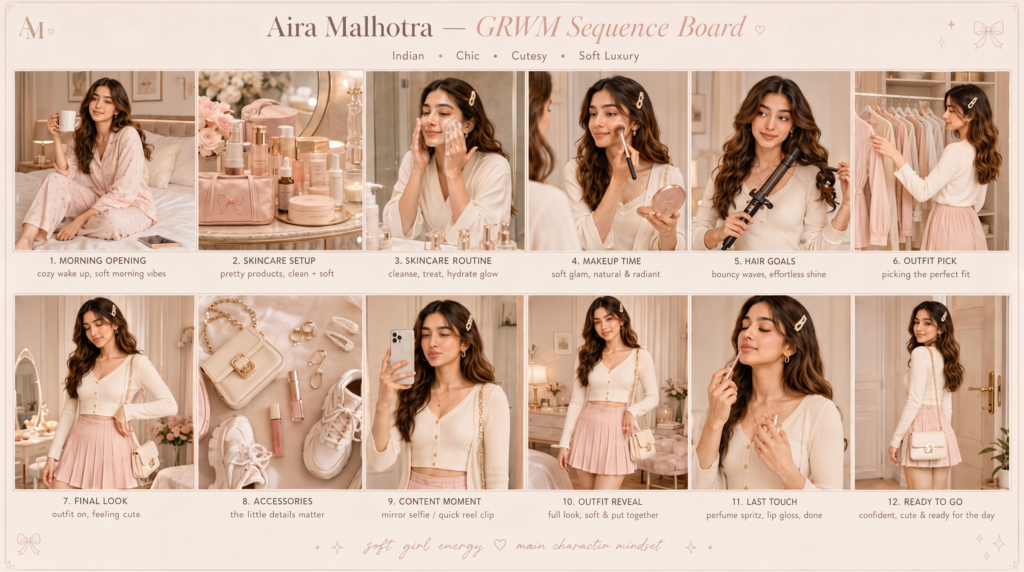
For example, imagine creating a complete GRWM sequence board of an Indian fashion and beauty influencer.
The board includes her morning opening, skincare setup, skincare routine, makeup time, hair styling, outfit selection, accessories, content moment, outfit reveal, last touch, and final ready-to-go shot.
The model is no longer inventing everything from scratch.
It has a visual blueprint.
That is the unlock.
Why This Example Matters
The GRWM example shows why Seedance 2.0 feels like a different category of tool.
The prompt itself is not extremely complicated. It is not a 500-word technical prompt. It is simple, clear, and production-oriented.
But the reason it works is because the reference image already does the heavy lifting.
The character is defined.
The styling is defined.
The color palette is defined.
The scene order is defined.
The mood is defined.
The camera world is defined.
The content format is defined.
Seedance can then focus on what it is good at: bringing the sequence to life.
This is a very different way to think about AI video.
The prompt is no longer the whole creative direction.
The prompt becomes the instruction layer on top of a strong visual system.
Prompting Is Becoming Less About Words and More About Taste
Most people think prompting is about writing better sentences.
That is only partly true.
In AI video, prompting is becoming about taste.
The best outputs come from people who understand visual language.
They know what warm luxury lighting looks like.
They know what a realistic influencer room should feel like.
They know when skin looks too plastic.
They know when motion feels too smooth.
They know when an AI scene looks fake because it is over-lit.
They know how to make a moment feel observed instead of staged.
This is why “cinematic” alone is not enough.
Everyone writes cinematic.
But cinematic can mean dark Netflix thriller, clean Apple commercial, dreamy Korean skincare ad, chaotic handheld documentary, or glossy perfume film.
A good prompt defines the exact cinematic world.
For the GRWM example, the visual world is not just cinematic. It is soft luxury influencer cinema.
That means warm practical lighting, gentle movement, delicate transitions, soft fabric textures, pastel styling, realistic beauty routine gestures, and natural camera rhythm.
Seedance 2.0 Makes Sequence Boards More Valuable
This is a huge shift for creative teams.
Earlier, a storyboard or moodboard was mostly a pre-production asset. It helped clients imagine the shoot before anything was filmed.
Now the storyboard can become the source material for the AI video itself.
That means a designer can create a 12-frame campaign sequence using GPT Image 2 or another image model. Then Seedance can use that visual system to generate a realistic motion version.
This makes sequence boards more powerful than ever.
A beauty brand can test a GRWM campaign before shooting.
A fashion brand can test outfit reveal reels.
A food brand can test recipe videos.
A real estate brand can test lifestyle walkthroughs.
A fintech brand can test founder-led explainers.
A D2C brand can test product routines.
An agency can pitch three different campaign routes in video form before production begins.
This does not remove the need for real shoots.
But it changes what happens before the shoot.
The idea can be seen earlier.
The client can approve faster.
The creative direction can become clearer.
The production team can understand the desired output better.
The brand can test multiple routes before spending on a full campaign.
Seedance Is Not Replacing Production Yet
It is tempting to say that Seedance 2.0 replaces video production.
That is not fully true.
There are still limitations.
Product accuracy can be difficult.
Hands can still behave strangely.
Faces may shift if the reference is weak.
Logos and text are still risky.
Complex multi-character scenes need control.
Exact brand assets may need post-production.
Final ad delivery may still need editing, sound design, grading, and human cleanup.
But for concepting, previsualization, social content testing, mood films, pitch videos, and early creative exploration, it is already extremely useful.
The correct way to use Seedance 2.0 is not as a magic button.
It should be used as a creative production layer.
The Best Prompting Formula for Seedance
A strong Seedance prompt should not be messy.
It should be clean, visual, and directional.
A useful structure is:
Subject
Scene
Action
Sequence
Camera
Lighting
Mood
Realism
Restrictions
For example:
“A cinematic influencer GRWM sequence featuring a stylish Indian creator in a soft luxury bedroom. Show her morning opening, skincare routine, makeup, hair styling, outfit selection, accessories, mirror selfie, final look, and ready-to-go moment. Warm creamy lighting, pastel pink and beige palette, elegant transitions, natural beauty gestures, realistic human motion, soft handheld camera feel, shallow depth of field, photorealistic skin texture, chic and aesthetic, no text overlays, no distorted hands, no fake glossy AI look.”
This gives the model a real production brief.
It tells Seedance what to show, how to move, what to feel like, and what to avoid.
The Real Skill Is Building the Input
The best AI video teams will not just write prompts.
They will build inputs.
That means:
Character sheets
Moodboards
Sequence boards
Product boards
Reference images
Camera references
Lighting references
Styling references
Shot-by-shot prompts
Negative prompt libraries
Brand-specific visual rules
This is where agencies can create real value.
Anyone can type “make a cinematic video.”
But not everyone can build a complete visual system that makes the video look intentional.
The GRWM example proves this clearly.
The prompt is simple because the reference is strong.
That is the future of AI video.
Strong inputs. Clear prompts. Better outputs.
What This Means for Brands
For brands, Seedance 2.0 opens up a faster way to test content ideas.
Instead of waiting weeks to visualize a campaign, a brand can now see a realistic draft in a day.
This is especially useful for:
Influencer campaigns
Beauty routines
Fashion reels
Product demos
UGC-style ads
Founder stories
Launch teasers
Website hero videos
Campaign mood films
Performance ad variations
The brand does not need to immediately commit to a full shoot.
It can first test the world.
Does this tone feel right?
Does this character work?
Does this product routine feel natural?
Does this campaign have motion?
Does this look premium enough?
Does it feel too AI?
Can this become a real shoot?
That is a major creative advantage.
What This Means for Agencies
For agencies, Seedance 2.0 creates a new service layer.
The agency can move from static moodboards to motion moodboards.
Instead of only presenting campaign routes as slides, agencies can present living campaign directions.
A beauty campaign can be shown as a realistic GRWM sequence.
A restaurant campaign can be shown as a cinematic food moment.
A real estate campaign can be shown as a lifestyle walkthrough.
A fintech campaign can be shown as a day-in-the-life visual story.
A fashion campaign can be shown as an outfit transition reel.
This makes creative pitching stronger.
Clients do not have to imagine as much.
They can see the idea.
The Future Is Not Prompt Engineering
Prompt engineering sounds too technical.
What we are actually moving toward is creative direction.
The best people using Seedance will not be the ones who know secret keywords.
They will be the ones who understand storytelling, framing, lighting, styling, emotion, realism, platform behavior, and brand tone.
They will know how to make something feel less AI and more human.
They will know when to use a reference image.
They will know when to use a sequence board.
They will know when to keep the prompt simple.
They will know when to control the shot.
They will know when to stop over-directing.
That is the new skill.
Not prompting.
Directing.
Final Takeaway
Seedance 2.0 changes everything because it makes AI video feel more controllable, more realistic, and more useful for actual creative work.
But the real breakthrough is not just the model.
The breakthrough is the workflow.
When you combine a strong visual reference, a clear sequence board, and a simple but well-directed prompt, AI video stops feeling like a random experiment.
It starts feeling like a production tool.
The GRWM example proves the point perfectly.
A single beautifully designed sequence board can become a realistic influencer video with the right Seedance prompt.
That is why the future of AI video will belong to creative teams who can think visually before they prompt.
There is a strange pattern showing up in Google Search Console for many brands.
Impressions are going up. Clicks are going down.
On the graph, it looks like a crocodile opening its mouth. The top jaw is impressions rising. The bottom jaw is clicks falling. This is now commonly called the Crocodile Mouth effect.
For marketers, founders, and SEO teams, it is one of the clearest signs that search behavior has changed.
People are still searching. Your brand is still being discovered. But users are not always clicking anymore.
Why?
Because Google AI Overviews, featured snippets, knowledge panels, Reddit threads, YouTube summaries, and AI chatbots are increasingly answering questions directly before a user reaches your website.
This is the zero-click reality.
The goal is no longer just to rank. The goal is to become the answer.
Why the Crocodile Mouth Effect Is Happening
Traditional SEO was built around one simple journey:
Search → Click → Website → Conversion.
But today, the journey often looks like this:
Search → AI answer → Brand mention → Later action.
A user may ask Google, ChatGPT, Perplexity, or Gemini a question and get a complete answer without visiting any website. For informational queries, this means the click may disappear completely.
For example, a user searching “best SEO agency in Mumbai for startups” may not click through ten agency websites. They may read an AI Overview, check a few brand names, look at Google Maps, skim Reddit or YouTube, and then search the brand directly later.
This means brands need to optimize not only for search rankings, but also for AI visibility, brand recall, local discovery, and action-driven intent.
Optimize for AI Overviews, Not Just Google Rankings
SEO is evolving into AEO: Answer Engine Optimization.
AI tools do not simply look for keyword-stuffed pages. They look for clean, structured, trustworthy answers that can be easily extracted, summarized, and cited.
To improve your chances of being included in AI Overviews, structure your content clearly.
Start every important page or blog with a direct answer in the first one or two sentences. Then expand with short paragraphs, bullet points, comparison tables, FAQs, and practical examples.
For example, instead of starting with a long introduction like:
“Digital marketing has changed a lot over the years…”
Start with:
“The Crocodile Mouth effect in SEO happens when Google Search Console impressions rise while clicks fall, usually because users are getting answers directly from AI Overviews, snippets, or search results without visiting the website.”
That is the kind of answer AI can understand quickly.
Use Proprietary Data and Real Case Studies
Generic content is easy for AI to summarize and ignore.
Unique content is harder to replace.
Brands should publish original insights, local market observations, campaign learnings, case studies, customer data, pricing benchmarks, and experience-based opinions.
For a Mumbai-based brand, this could include:
“Based on our campaigns for Mumbai real estate brands, lead quality from hyperlocal landing pages outperformed generic city-wide pages.”
For an e-commerce brand, it could be:
“Across performance campaigns, product pages with creator-led UGC assets saw stronger engagement than static catalog creatives.”
These kinds of insights make your brand more useful as a source. AI systems are more likely to reference pages that contain specific, experience-backed information rather than recycled generic SEO blogs.
Think Beyond Google: Search Is Everywhere Now
Your customers are no longer searching only on Google.
They are searching on YouTube, Reddit, Instagram, LinkedIn, TikTok, Google Maps, Perplexity, ChatGPT, and Gemini.
This means your brand needs to appear across the platforms where people and AI systems discover information.
For Mumbai businesses, this is especially important. A user looking for a service may check Google Maps, Instagram posts, YouTube reviews, Reddit discussions, and AI recommendations before making a decision.
Your brand should be visible in all these discovery paths.
That means:
Google Business Profile should be updated.
YouTube videos should answer actual customer questions.
Reddit and Quora discussions should mention your category naturally.
Instagram and LinkedIn should carry strong brand signals.
Website pages should clearly explain what you do, where you operate, and why you are credible.
Search is no longer one platform. Search is an ecosystem.
Win Local Search in Mumbai
For Mumbai-based businesses, local SEO is still a major opportunity.
AI may answer general questions, but users still need to take action when they are looking for a nearby service, agency, clinic, restaurant, store, consultant, or vendor.
That is where local optimization matters.
Your Google Business Profile should have updated services, photos, reviews, location details, business hours, website links, and FAQs.
Your website should also include location-specific pages where relevant.
For example:
“Performance Marketing Agency in Mumbai” “SEO Agency for D2C Brands in Mumbai” “Branding Agency for Real Estate Companies in Mumbai” “Website Design Agency in Andheri” “Social Media Marketing Agency for Restaurants in Bandra”
These pages should not be thin keyword pages. They should include examples, local context, pricing indicators, service details, testimonials, and clear CTAs.
The more specific and useful the page, the better your chance of converting high-intent traffic.
Focus on Action-Driven Long-Tail Keywords
Informational searches are most vulnerable to zero-click behavior.
Queries like “what is SEO” or “what is performance marketing” can easily be answered by AI.
But action-driven queries still have click potential because the user needs to compare, book, buy, contact, or sign up.
Instead of only targeting broad keywords, brands should target long-tail commercial intent queries such as:
“SEO agency in Mumbai for SaaS companies” “performance marketing agency for real estate leads” “Shopify website design agency in India” “best influencer marketing agency for UAE fintech brands” “AI creative agency for Meta ads” “Google Ads agency with landing page support” “branding agency for premium D2C brands”
These searches indicate that the user is closer to taking action.
The more specific the intent, the more valuable the click.
Build Brand Recall Even Without the Click
In a zero-click world, the user may see your brand but not visit your website immediately.
That is why brand recall matters.
Your content should include memorable positioning, clear service language, strong visual identity, and repeated brand identifiers.
If AI summarizes a topic and includes your brand as one of the sources, the user should still remember who you are.
For example, Social Donut should not just be described as a “digital marketing agency.”
It should be positioned as:
“A design-first marketing agency helping brands grow through branding, content, performance marketing, SEO, websites, and AI-led creative systems.”
That is more memorable. It gives the brand a sharper identity.
In the AI search era, vague brands disappear. Specific brands are remembered.
Make Every Page Conversion-Ready
Since fewer users may click, every click that does come through becomes more valuable.
Your landing pages, blogs, service pages, and case studies should not only educate. They should move the user forward.
Every important page should include:
A clear opening answer
Proof of expertise
Examples or case studies
FAQs
Internal links
Strong CTA
Contact or booking option
Trust signals
Local relevance, where needed
The goal is to turn your website from an information library into a conversion engine.
What Brands Should Do Now
The Crocodile Mouth effect is not a reason to panic. It is a sign that SEO needs to evolve.
Brands should stop thinking only in terms of rankings and start thinking in terms of visibility, authority, recall, and action.
The future of SEO will belong to brands that can answer clearly, prove credibility, show up across platforms, and convert high-intent users when they are ready to act.
At Social Donut, we believe the next phase of search is not just about getting more traffic.
It is about becoming impossible to ignore.
Final Takeaway
If your impressions are rising but clicks are falling, your SEO is not necessarily failing.
Your content may already be visible.
Now the job is to make it more useful, more memorable, more conversion-focused, and more AI-friendly.
Because in the age of AI Overviews and zero-click search, the winning brands will not just rank.
They will become the answer.
This website uses cookies to ensure you get the best experience on our website.